

 ENG
ENG 



65+ Years
Team experience
10000+
Smiling patients
30000+
Implants placed.


Introduction
Dentures and dental implants are two very different solutions for replacing missing teeth. Dentures are removable and rest on the gums, while dental implants are fixed and anchored in the jawbone. This fundamental difference is why dental implants are the preferred option for patients seeking better stability, comfort, and long-term results.
While implants are often assumed to be significantly more expensive, that is not always the case—especially with more efficient treatment models and in-house workflows.
What Are Dentures?
Dentures are removable prosthetic teeth that rest on the gums and are held in place by suction or adhesives. While they can restore basic appearance, they often shift during eating or speaking and can lead to progressive bone loss.
What Are Dental Implants?
Dental implants are fixed replacements anchored directly into the jawbone. For patients missing most or all teeth, solutions such as All-on-4 use just four implants to support a full arch of permanent teeth
Because implants fuse with the bone, they provide strong stability, improved chewing function, and help preserve jawbone structure.
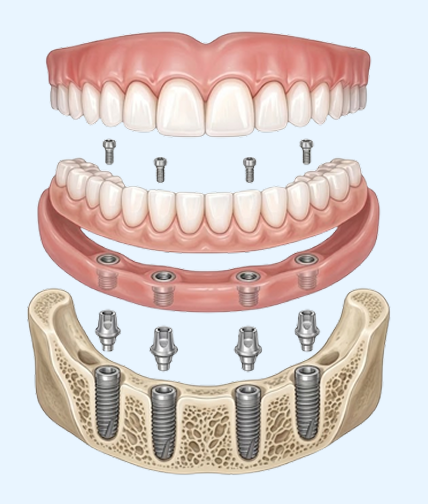
 Denture
Dental Implant
Denture
Dental Implant
Dentures vs Dental Implants – Key Differences
| Feature | Dentures | Dental Implant |
|---|---|---|
| Stability | Dentures can slip or move during daily activities. | Dental implants are fixed and non-removable, providing consistent stability. |
| Comfort | Dentures often cause sore spots and require ongoing adjustments. | Dental implants feel more natural and remain securely in place. |
| Chewing Ability | Dentures limit food choices and reduce bite strength. | Dental implants restore stronger chewing function, allowing for a more normal diet. |
| Appearance | Dentures can lose fit as the jawbone shrinks. | Dental implants help maintain natural facial structure. |
| Bone Health | Dentures contribute to ongoing bone loss. | Dental implants stimulate the jawbone and help preserve bone over time. |
| Maintenance | Dentures must be removed daily for cleaning. | Dental implants are maintained like natural teeth |
| Long-Term Results | Dentures often require relining, adjustments, or replacement. | Dental implants are designed for long-term stability and durability. |
| Cost Considerations | Dentures usually have a lower upfront cost, but ongoing adjustments, relines, and replacements can increase total cost over time. | Dental implants involve a higher initial cost, but with modern treatments, they're more accessible than patients think. |

Who Is a Good Candidate?
Dentures may be suitable if you:
-
 Prefer a non-surgical, lower-cost removable option
Dental implants (including All-on-4) are generally the better choice if you want:
-
A fixed, non-removable solution
-
Stronger chewing ability and natural feel
-
To preserve bone and facial structure
-
Have worn dentures long-term
-
Long-term comfort and confidence
A consultation with 3D imaging is required to determine the best option for your situation.
Which Option Is Better?
While dentures can provide a basic removable solution, dental implants — particularly All-on-4 — offer superior stability, function,
and long-term results for most patients.
Advanced dental implant options make it possible to achieve fixed, stable teeth even in complex cases.
👉 Visit Our Locations to find the nearest center and schedule a consultation.